
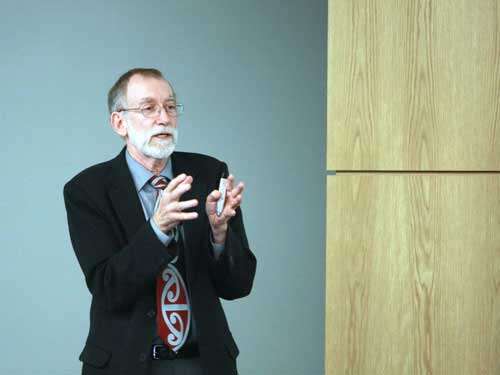


Although every seat was taken by both those eager to be enlightened and those looking to disagree, a full auditorium did not discourage those determined to be members of the audience in LI 120 on Nov. 19, who lined up determinedly against the back wall. The Fifth Annual Symposium on Restorative Justice and the Death Penalty was excessively attended by those itching to hear Howard Morton, Michael Radelet and Howard Zehr present on issues surrounding around capital punishment and restorative justice.
The road to restoration and recovery
Known as the “Grandfather of Restorative Justice” Howard Zehr, a professor of Sociology and Restorative Justice at Eastern Mennonite University in Harrisonburg, Virginia, presented on the process of restorative justice for victims.
He has worked intimately with victims and their families in trying to identify and accommodate their recovery needs.
“A woman had two children with her husband from whom she was separated, and he had the right to have the children on certain holidays. On Christmas eve, he showed up all excited to take the children out to eat, and when she went to pick them up on Christmas day, she found he had murdered both of them and killed himself,” Zehr said, speaking about one woman who has informed his research, along with many other victims who have benefitted from his restorative approach.
Zehr emphasized the need of these victims to transcend the trauma they have experienced, but also recognized the fact that the transcendental factor will be different from individual to individual.
“When I talk with a rape victim and a burglary victim, I can’t always tell the difference because people go through a range of emotions and they all deal with things differently,” Zehr said.
He maintained that many people do not understand the survivor experience and the disorder, dis-empowerment and disconnection victims often feel. He explained their healing process as a series of journeys that work towards a restoration of meaning, honor, vindication and justice.
“I think our need to exchange Christmas gifts and our need for revenge comes from the same place. We think we need to balance the score – it is a basic human need – but there are different ways to do it,” Zehr noted.
He explained that there is an entire series of needs that need to be met after being victimized and claims that if we address those needs in the justice process, people can resume their journey more easily and are less likely to need revenge.
These needs include safety, information, a sense of order and a possible encounter with the offender. Not to promote forgiveness, Zehr emphasized, but merely to facilitate reconciliation if it will assist the recovering victim in any way.
“I believe we should reform the current system to make it more restorative,” Zehr said. “We need to change the questions to focus on the victims.”
Advocating for the voiceless
In 1975 Howard Morton found out that his first-born son, Guy Oliver Morton, had been stabbed in the back and murdered in a desert outside of Pheonix, Ariz.
Each of Guy’s siblings dropped out before graduating high school so they wouldn’t pass up their brother.
The Morton’s marriage faltered resultant of the the depression and despair experienced by a grieving mother, and a suffering father who believed he had failed to protect his son.
Guy’s murderer was never found and the case became cold as the authorities developed new priorities. After participating in support groups and other forms of counseling, the Morton family realized they needed to be productive with the experience they endured and keep it from happening to other families.
Thereafter Howard Morton co-founded Families of Homicide Victims and Missing Persons, Inc. in Colorado for which he is the Executive Director.
“I am neither abolitionist or for the death penalty, I stand for neither restorative nor retributive justice, nor do I seek vengeance against those who murder,” Morton said. “I come to this symposium as an advocate of those family members and friends who suffered the loss of a loved one to a murder for which no one has ever been prosecuted. I am an advocate for justice for those whom our system has forgotten.”
Morton explained that nationally, four out of 10 people are getting away with murder. Although his home state of Colorado has only executed one person in the past 40 years, it spends 3 million to maintain the death penalty annually. He believes that our current system doesn’t invest enough resources in pursuing homicide cases, and proposed that it would be a more effective use of money to allot it to a cause which meets the need of survivors and solves the cases of victims, rather than using it to maintain the death penalty. “The number one thing a survivor wants is to find out who killed their loved one,”Morton said. “They want to speak for those who can’t speak for themselves.”
Make healing the priority
Michael L. Radelet, Professor of Sociology at University of Colorado Boulder and death penalty scholar with particular interest in social justice, urged audience members to rethink the death penalty.
Radelet observed that the most prevalent argument for maintaining the death penalty today is the supposed consolation factor for the families of homicide victims.
He gave the pivotal statistic that while in 1961, 94 percent of homicides were solved by arrest, today only 60 percent of those cases are solved.
“Even if an individual supports the death penalty, they would rather help others who don’t even know who killed their loved one, who don’t know what their last hours were like,” Radelet said.
Averaging 3.5 million dollars per execution, Radelet pointed out that the death penalty is much more expensive than life without parole which averages $20,000 per year.
“I’m not making the argument that the death penalty doesn’t help the families of homicide victims, but I am suggesting that the money could be used more wisely.”
Radelet said.
Pointing out that 635,000 people have been murdered in the U.S. since 1977, only 7,500 have been sentenced to death, and only .2 percent of homicides actually result in execution.
“Why don’t we ask the families of homicide victims how we could better spend this money?”
In correlation with Howard Morton’s call to action in unsolved homicide cases, Radelet supports the development of cold case squads, to be hypothetically funded by the money formerly spent on the death penalty, which would dedicate all efforts to unraveling unsolved cases which have lost priority with law enforcement.
Radelet believes the needs of families of homicide victims are largely neglected not only by government but also the community.
“When someone is murdered it is difficult to know what to say and we don’t encourage their families to talk, “ Radelet said. “We need to listen to them and make their healing the priority.”
Professor Alan Clarke J.D., LL.M:
As an Associate Professor in the Integrated Studies Program, five years ago Clarke initiated the first Death Penalty Symposium on the UVU campus. Clarke has extensive experience with Indian law, capital murder and habeas corpus including death row representation.
“When I was about three I remember walking down the street with my mom and talking about what happens to you when you’re bad. She would say ‘If you are bad you get sent to your room, and if a you are really bad you might get a spanking,’ and I asked her what happens when you get older, and she said ‘You might have to pay a fine or go to jail, and if you are really really bad they may actually kill you, but it is never right to kill.’ I think back to that time and know my mother’s words had an impact on me even as a three-year-old child. More fundamentally, I came to oppose the death penalty through practical law experience and by seeing how it works in the real world. There are all sorts of reasons to oppose the death penalty. It isn’t an effective deterrent, it doesn’t incapacitate well, it is racist in application, and we know that innocent people are being killed. When you think of a person who has done something really horrible, perhaps committed murder, if you support the death penalty what you’re saying is their whole being will always defined by the worst thing they have ever done. Even life without parol is throwing a person away, saying they can’t be salvaged, and that the only way to keep ourselves safe is to lock them up for life. In some cases it’s true, but it applies to a very small minority. Every human being has done things they aren’t proud of, yet most people shouldn’t be defined by their worst act. Restorative justice focuses on the humanity in all of us, even in the people who have done evil things, and gives people who want to change a chance to make that change. We began this symposium because if you oppose the death penalty and support alternatives like restorative justice, you cannot just preach to the converted, you have to try to reach the places where it is most adamantly supported, which is how we have gotten really top notch people to come and speak about these important issues at UVU. We have tried to bring in a variety of perspectives including legal, restorative justice and sociology scholars in order to encourage an interdisciplinary approach.”
Dr. Sandy Mcgunigall-Smith:
A UVU Associate Professor of Behavioral Science, Sandy is a criminologist with particular interest in studying the quality of life for death sentenced inmates and those sentenced to life without parole.
“I have always been opposed to the death penalty. At the core of my reasoning there is something inside of me which says it’s wrong. We are not sophisticated enough to be dealing with the death penalty. If you look in any prison in the United States, the number of people who have committed homicides is quite high compared to the number of people on death row, so what is happening here? These are not necessarily the people who have committed the most heinous offenses, a lot of it comes down to the quality of representation in court as well as race and social class. The people I have been talking to over the years are not Hannibal Lecters, they don’t fulfill the stereotype of hanging onto the bars with blood dripping down their chin. If you set their crime aside they are quite unexceptional people. While there are many people on death row who still have a lot to contribute to society, I would be a fool if I didn’t recognize that there are some who should never be let out onto the streets again. Many students ask me questions such as, ‘How would you feel if it was your eight-year-old granddaughter raped and murdered?’ My response is that I would probably want to kill them with my own bare hands as slowly and as painfully as possible, but that doesn’t make it the right thing to do. This symposium addresses issues with the death penalty and the alternative of restorative justice in addressing the needs of victims. Everybody is different and deals with grief in a different way and it is important to consider a victim’s needs and what would bring them personal restoration.”
Dr. Michael Minch:
An Associate Professor in Humanities and Philosophy as well as the Director of the Peace and Justice Studies Program, Dr. Minch’s areas of study include peace and justice and the relationship between political theory, politics and christian theology.
“There are two sets of reasons to be opposed to the death penalty. The first is that it isn’t administered fairly and irreversible mistakes are made. These pragmatic moral issues are reason enough to oppose the death penalty. I also happen to think the death penalty is intrinsically wrong. It is hypocritical to say ‘You killed someone, I’m going to kill you.’ If the prisoner is locked up they are no longer a threat, and to kill someone at that point seems nothing other than an act of vengeance and immoral by definition. It is easy to say ‘Capital punishment is immoral,’ the difficulty lies in figuring out a solution. Restorative justice is an important movement in respect to answering that question. All the research tells us when an offender has the opportunity to make some amends for their crime, and when the survivors see that the murderer is making a good faith effort, a degree of healing takes place whereas with the death penalty all that results is bitterness, resentment and anger. Our focus should be on finding restoration for victims and protecting society rather than punishing someone which I think is mean spirited and inhumane. As with the former institutions of slavery and women’s inequality, I believe the death penalty is on it’s way out of our society. Peace & Justice Studies co-sponsored this year’s symposium with other campus entities, and it’s focus has evolved from the death penalty as a singular subject, to a broader set of issues involving restorative justice and victim response to murder.”
Professor Nancy Rushforth:
An Associate Professor of Humanities and Philosophy, Rushforth is also a certified Thanatologist which makes her an expert on death and the grief experienced afterwards by family members of victims.
“I am pretty adamantly against the death penalty because I don’t think violence can compensate for violence, it only perpetuates the existing violence in our culture. I also believe that the death penalty is arbitrary and unfairly administered. Since the ban has been lifted on the death penalty there have been approximately 600,000 homicides, but we have only executed approximately 1,100 individuals. While I think this is far too many, it makes me question the determining factor for executing some and not all of the people who commit these crimes. People often think we only execute those who have committed the most heinous crimes, and while I think the system would like to work that way, it doesn’t. We know that we have convicted innocent people and have so far exonerated 139 death row inmates. There is a preconceived notion that the death penalty deters, but while there have been 45 executions this year with 10 more pending, the media rarely informs the public about these cases, which would eliminate the deterrent effect. I think we need a lot of reform throughout our justice system, not just in dealing with the death penalty. It is important to have conferences like this where these issues can be discussed from a variety of perspectives. There is a lot of misperception about the death penalty and a lot of education needs to take place through out the country and if we hold a seminar to inform our citizens, others may take notice and follow suit.”


