
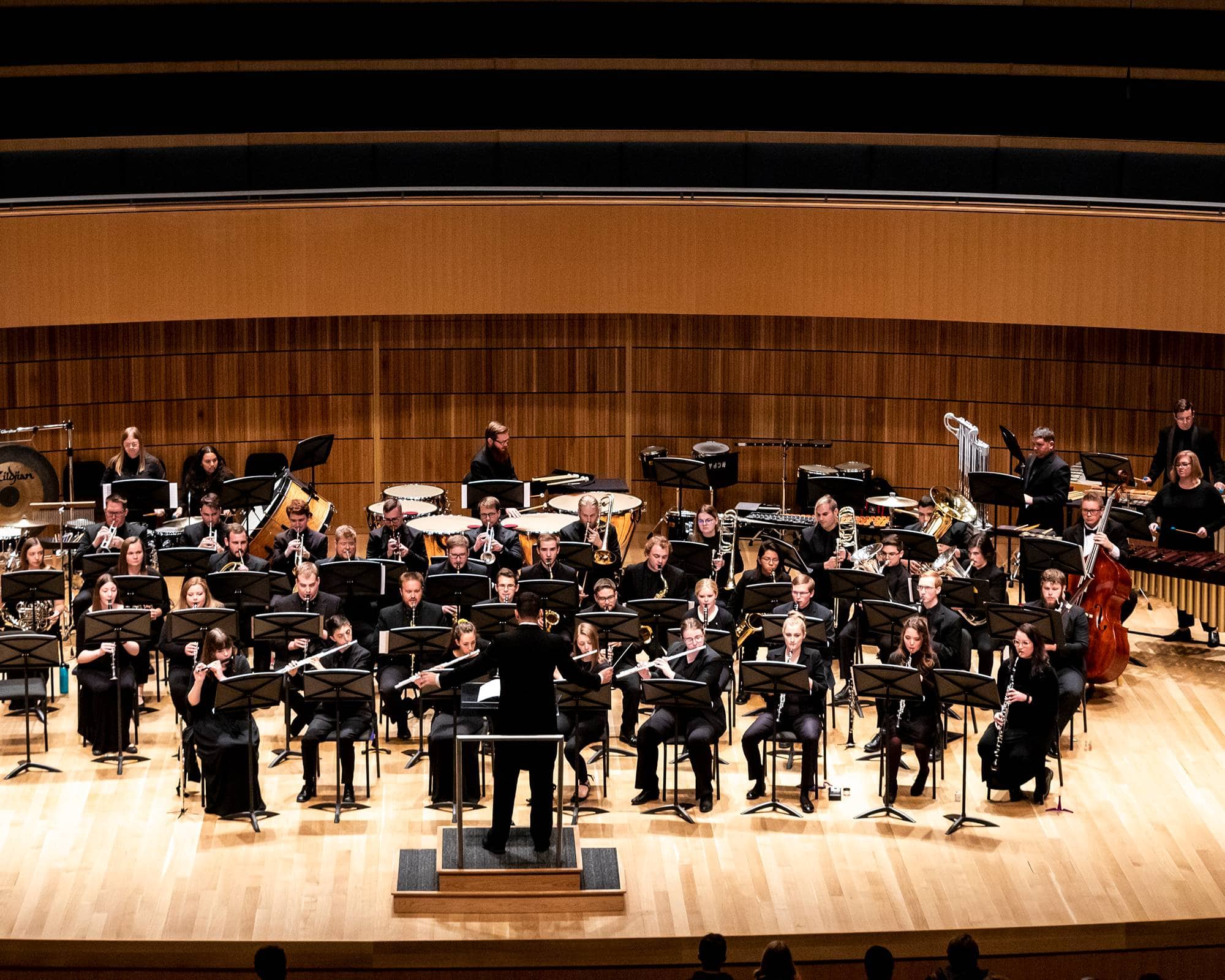

“This will be our reply to violence: to make music more intensely, more beautifully, more devotedly than ever before,” said the conductor of the UVU Wind Symphony, Dr. Chris Ramos. He opened the UVU Wind Symphony’s Oct. 1 performance with messages from his students, who had fought to make the performance happen. He took special care to quote one of those students, who in their personal submission, had listed the above quote from renowned composer and conductor Leonard Bernstein. Bernstein made that statement in response to the assassination of John F. Kennedy. And the student who submitted the quote did so in response to the violence that occurred on UVU’s campus on Sept. 10.
After the message of courage and hope was given on stage by Dr. Ramos, the performance began, with a celebratory fanfare from the visiting Woods Cross High School Wind Ensemble under the watchful baton of their director, Todd Campbell. This 64-body ensemble showcased togetherness and strength in their performances of the “Celebration Fanfare” alongside Gustav Holst’s second suite, finishing their set with roaring applause from the audience.
UVU Wind Symphony then took to the stage, wearing their traditional concert black with an accent color of green. Their performance filled the hall with sound and silence at different turns. Through their three-piece program, this 54-person symphony showed magnificent highs and lows that were so soft they almost felt eerie. Between each piece, students came and introduced the composer, the piece, and often they also mentioned the compositional context.
Dr. Ramos also included a conductor’s statement in the program, written before Sept. 10, but stands out to an audience all the same. “There are seasons in life when we find ourselves standing at an edge—the twilight where light and darkness mingle—trying to decide whether to plant our feet or to step,” he writes, expressing the overall theme of the performance, detailing later how the poster of this performance, in its depiction of “the fool” with bells on his cap.

He then elaborated on the song choices and how they relate to the theme, which added even more meaning to the spoken interludes during the performance itself. “David Maslanka’s Traveler opens not as a farewell but as a stride. He [Maslanka] framed the piece around Bach’s chorale, ‘Nicht so traurig, nicht so sehr’ (‘Not so sad, not so much’), and wrote of feeling not an ending, but a gathering of what has been and a projection into what might yet be.”
Ramos introduced the second piece played that night, “In This Breath” by Shuying Li, by saying “[it] lives at a quieter threshold—the place where one inhalation meets the next, and where grief is transfigured into continuity.” The last piece of the night, Linsday Bronnenkant’s “Tarot”, had three movements, “The Fool”, “The King of Cups”, and “The Tower”. Incidentally all these movements represented different tarot cards with different meanings that showcased the piece in new ways.
He details those meanings in the intentional comedy of “The Fool”, the careful balance of the “King of Cups”, and the necessary storm of “The Tower”, ending the night with a piece that ties together all the previous meanings. And though unintentional at first, a program that also helped to bring emotions from the month past.
He ends his thoughts with one last tie back to the bells on the cap of “The Fool”, saying, “If there is a single image that threads these works together for me, it is the little bell cap—the permission to wonder aloud.” This performance exhibited wonder, stillness, and emotional depth. In a time of still existing turmoil at UVU, 100+ musicians at different places in life shared a stage and brought the audience the permission to wonder aloud.
See more Noorda events—both the series and the School of the Arts events on their page here: Noorda Center for the Performing Arts


